
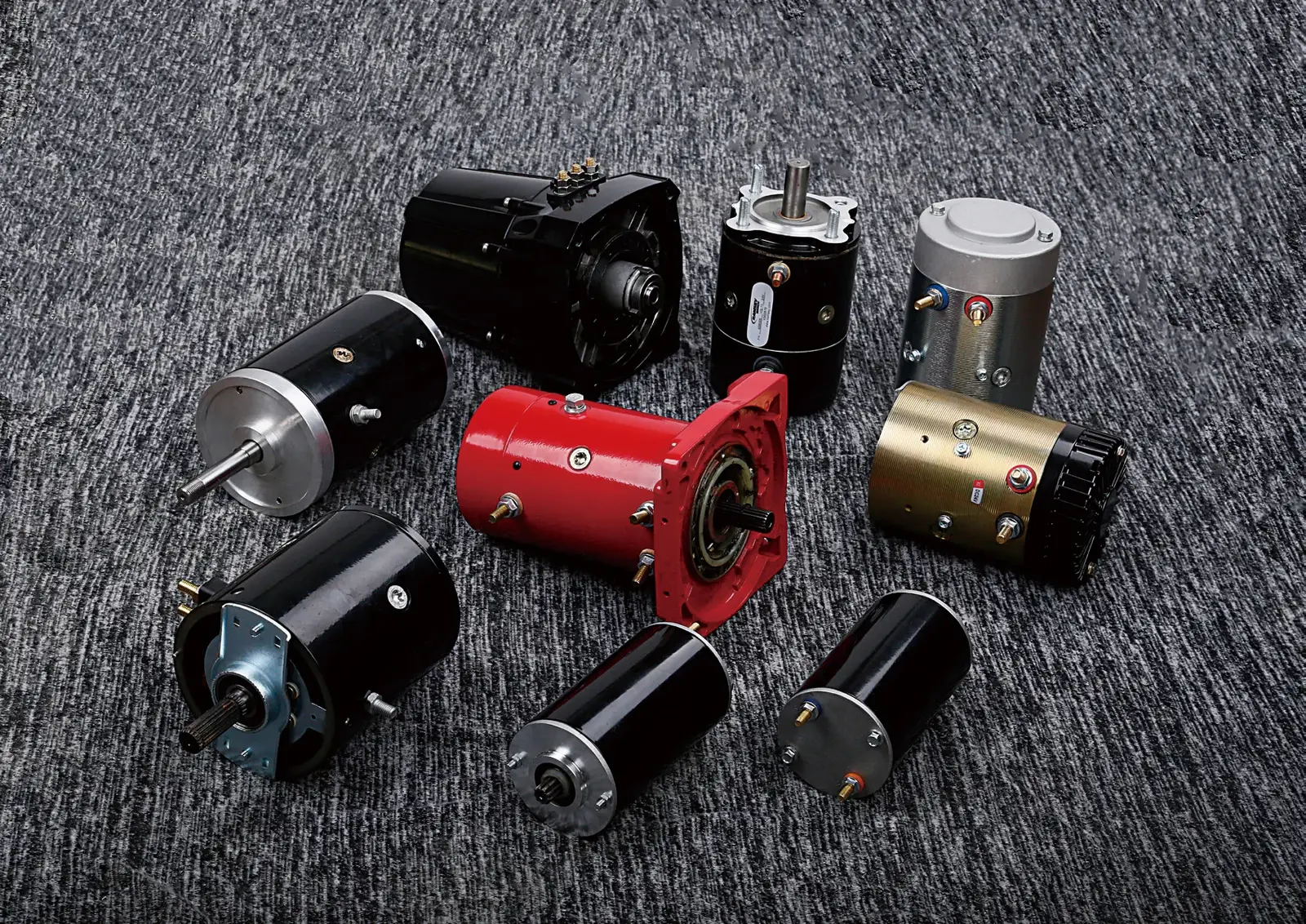
A hydraulic power unit (HPU) is only as reliable as the DC motor spinning its pump. Pick the right motor and the unit lifts smoothly for years; pick the wrong one and it overheats, stalls under load or fails early. This guide covers the five specifications that matter most, in the order we recommend checking them.
What voltage should the motor be — 12V or 24V?
The vehicle's electrical system decides. Cars, pickups and light trailers run 12V systems; trucks, buses and most industrial vehicles run 24V. At the same power output, a 24V motor draws roughly half the current of a 12V motor — which means thinner cables, cooler connections and less voltage drop on long runs. If your platform offers both, 24V is usually the more forgiving choice for power units above 2 kW.
How much power and torque does the pump need?
Motor power must match the hydraulic load: system pressure (bar) × flow (L/min) determines hydraulic power, and the motor must supply that plus pump losses. For common tail lift and dump trailer units, motors between 800 W and 2,200 W cover most duties; heavy applications like large tail lifts or aerial platforms step up to 3,000–4,200 W. Rated torque matters because gear pumps load the motor from the first revolution — a motor that produces its torque only at high RPM will struggle to start under pressure.
What does the duty cycle rating actually mean?
DC power unit motors are not continuous-duty machines. They are rated S2 (short-time duty) and S3 (intermittent duty). A typical rating like S2 2.5 min · S3 9% ED means the motor can run 2.5 minutes continuously from cold, or repeat cycles where it runs 9% of the time. That fits how real power units work — a tail lift raises for 20 seconds, then rests. Exceeding the duty cycle is the most common cause of premature failure: heat builds faster than the motor can shed it.
Which IP rating do you need?
| Location of the power unit | Recommended protection |
|---|---|
| Inside a cabinet or vehicle body | IP54 |
| Exposed on a chassis, washed regularly | IP54 with sealed connections |
| Exposed to immersion, mud or fording | IP67 |
IP54 (dust-protected, splash-proof) suits most enclosed power packs. If the motor lives under a trailer where it sees pressure washing or standing water, specify IP67.
Insulation class and why Class F is standard
Insulation class defines the maximum winding temperature the motor tolerates. Class F allows 155 °C — enough headroom for intermittent duty at full load. All Bonte hydraulic power unit motors use Class F insulation as standard.
A worked example
A 24V tail lift unit needing ~2 kW with repeated 30-second lifts maps directly to a motor like the Bonte BT22FD-24V: 24 V, 2,200 W, 8 N·m rated torque, S2 2.5 min · S3 9% ED, Class F, IP54. For a 12V trailer application at similar power, the BT22WB-12V offers 2,200 W at 12 V.
Get the spec checked by the factory
Send us your pump displacement, system pressure, duty pattern and mounting interface — our engineers will confirm the right standard model or quote a custom winding. It costs nothing to check, and it is much cheaper than replacing a mis-specified motor in the field.