
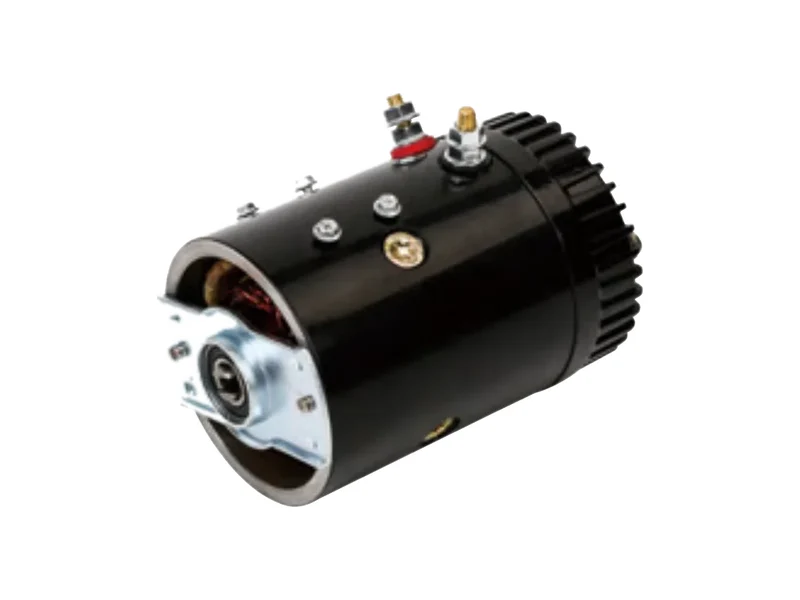
Most Bonte motor series are wound for both 12V and 24V. The mechanical output can be identical — so which should you choose? The answer is usually decided by physics and the vehicle, not preference.
The current problem
Power = voltage × current. A 2,200 W motor draws about 220 A at 12 V but only 110 A at 24 V. That factor of two changes everything downstream:
| Factor | 12V system | 24V system |
|---|---|---|
| Current at 2.2 kW | ~220 A | ~110 A |
| Battery cable size | Very heavy gauge | Half the copper |
| Voltage drop sensitivity | High | Lower |
| Contactor / solenoid wear | Faster | Slower |
| Availability in cars & pickups | Native | Requires converter |
| Availability in trucks & buses | Rare | Native |
When 12V is the right answer
If the motor runs from a car, pickup, van or light trailer electrical system, 12V is native — no converters, standard batteries, simple wiring. Recovery winches are the classic case: they are installed on 12V vehicles, so 12V winch motors like the Bonte BT12000PLT (12 V, 2,000 W, IP67) dominate that market. Keep cable runs short and sized generously.
When 24V wins
Trucks, buses, agricultural and industrial machinery run 24V natively, and higher-power motors benefit most: at 3–4 kW, a 12V design would need enormous cables and punish its brushes and commutator with heat. That is why our highest-power hydraulic unit motor, the BT40LT-24V (4,200 W, 14 N·m), is a 24V design.
Does voltage affect motor lifespan?
Indirectly, yes. Lower current means less resistive heating in the windings, brushes and connections. Heat is the main ager of a DC motor — it degrades insulation, brushes and bearings. At equal power and duty, the 24V variant generally runs cooler and lives longer.
Practical selection rule
- Match the vehicle's native system voltage — always the first rule.
- If both are available and power exceeds ~2.5 kW, prefer 24V.
- If cable runs are long (rear-mounted power units, trailer winches), prefer 24V or upsize the cable.
- Confirm the duty cycle at the chosen voltage — ratings differ slightly between windings.
Unsure which winding fits your platform? Send us the application details and we will recommend the exact model — or wind a custom voltage variant for your OEM production.